Decanting Wine: Oxidation Reactions and the Unfolding of Flavors"

Aug 27, 2025 By

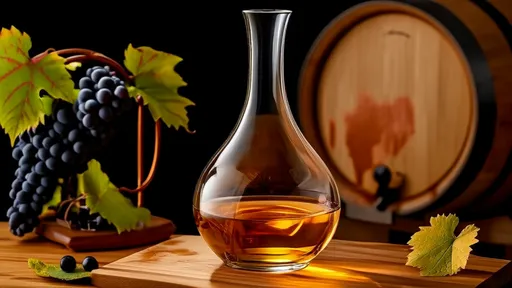
There exists a quiet ritual in the world of fine wine, a practice both revered and debated with near-religious fervor. It is the act of decanting. To the uninitiated, it might seem like a purely theatrical performance, an elaborate pouring of wine from one vessel to another. But for the connoisseur, it is a crucial alchemical process, a deliberate unlocking of a wine's deepest secrets. At its heart, decanting is a dance with oxygen, a carefully managed oxidation reaction that can transform a tight, brooding liquid into a symphony of aromas and flavors. This is the story of that transformation, the science and the soul behind letting a wine breathe.

The fundamental force at play when you uncork a bottle and pour its contents into a decanter is exposure to air, specifically the oxygen within it. Wine, particularly a young, tannic red or a tightly wound white, can be a closed book upon opening. Its compounds are bound up, its aromas muted, its structure often harsh and astringent. The primary goal of decanting is to accelerate the very slow process of oxidation that would eventually happen in the bottle over years, condensing it into a matter of minutes or hours. This controlled exposure triggers a series of chemical reactions that are nothing short of miraculous for the wine's character.

One of the most significant changes involves the management of tannins. These phenolic compounds, derived from grape skins, seeds, and stems, are crucial for a wine's structure and aging potential. However, in their youth, they can be aggressive, causing a drying, puckering sensation on the palate. When oxygen is introduced, it begins to soften these tannic chains. The molecules start to polymerize, linking together to form longer, smoother chains. This process doesn't eliminate the tannins; it refines them. The harsh, gritty edge is polished away, revealing a wine with a supple, velvety texture that feels integrated and harmonious rather than abrasive.

Simultaneously, a parallel reaction is occurring with the wine's aromatic compounds, or esters. Many of the complex fruity, floral, and spicy notes we adore in wine are volatile compounds trapped in a reduced state immediately after opening. The introduction of oxygen acts as a catalyst, volatilizing these compounds and carrying them to your nose. It's like opening a window in a stuffy room. A wine that initially smelled of little more than alcohol and primary fruit might, after some time in a decanter, suddenly burst forth with layers of scent: ripe blackberries, violets, vanilla, tobacco, and earth. This is the "bloom" or "awakening" that enthusiasts speak of—the moment a wine truly finds its voice and sings.

Furthermore, decanting serves a practical, albeit less glamorous, purpose: the separation of sediment. Older red wines, particularly those bottled without filtration, often throw a deposit of tannins and color pigments over time. This sediment is a natural byproduct of aging and is completely harmless, but it is bitter and gritty, detracting from the wine's clarity and pleasure. By pouring the wine steadily and gracefully into a decanter, leaving the last ounce with the sediment in the original bottle, one achieves a crystal-clear pour. This act of clarification ensures that every sip is visually appealing and free from any textural unpleasantness, allowing the pure, evolved character of the mature wine to shine through unimpeded.

Yet, decanting is not a one-size-fits-all solution. Its application requires discernment. A fragile, forty-year-old Burgundy might need only twenty minutes in a decanter to open up, and any more would cause its delicate bouquet to evaporate into nothingness—a phenomenon known as oxidation in the negative sense, where the wine loses its fruit and becomes flat and vinous. Conversely, a powerful, young Barolo or Cabernet Sauvignon might demand two, three, or even more hours to unwind its tightly coiled structure. The shape of the decanter itself plays a role; a vessel with a wide base maximizes the surface area of wine exposed to air, accelerating the process significantly.

The debate around decanting even extends to white wines. While less common, many full-bodied, oak-aged whites like White Burgundy or oaked Chardonnay can benefit tremendously from a brief decanting. It helps to integrate the oak-derived flavors, soften any sharp acidity, and promote a richer, more rounded mouthfeel. The key, as always, is timing and intention. It's about listening to the wine and understanding what it needs to express its fullest self.

In the end, the act of decanting is a bridge between the winemaker's art and the drinker's experience. It is a gesture of patience and respect for the liquid in the glass. It acknowledges that a great wine is a living, evolving entity. By facilitating this controlled oxidation, we are not merely aerating a beverage; we are participating in its final stage of maturation. We are coaxing out nuances that the winemaker embedded years ago, waiting for this very moment. The burst of flavor, the softening of texture, the unveiling of hidden aromas—this is the flavor eruption, the glorious payoff for those willing to wait. It transforms the simple act of drinking into an experience, a conversation with the wine that is as deep and complex as the decanter itself.

Recommend Posts
Romance

Snowball Effect: The Accumulative Impact of Ice and Snow Crystals

By /Aug 27, 2025

In the hushed stillness of alpine landscapes, a silent architectural marvel unfolds with each passing storm. The phenomenon of snow accumulation, often poetically termed the snowball effect, represents one of nature's most fascinating examples of incremental growth creating monumental consequences. What begins as microscopic ice crystals suspended in clouds evolves through complex atmospheric processes into the sweeping white blankets that define winter landscapes across mountainous regions worldwide.
Romance

Decanting Wine: Oxidation Reactions and the Unfolding of Flavors"

By /Aug 27, 2025

There exists a quiet ritual in the world of fine wine, a practice both revered and debated with near-religious fervor. It is the act of decanting. To the uninitiated, it might seem like a purely theatrical performance, an elaborate pouring of wine from one vessel to another. But for the connoisseur, it is a crucial alchemical process, a deliberate unlocking of a wine's deepest secrets. At its heart, decanting is a dance with oxygen, a carefully managed oxidation reaction that can transform a tight, brooding liquid into a symphony of aromas and flavors. This is the story of that transformation, the science and the soul behind letting a wine breathe.
Romance

Instant Chemistry: The Eternal Moment in Instant Film Developer

By /Aug 27, 2025

In an age where digital photography dominates with its flawless precision and infinite reproducibility, there exists a tangible magic in the imperfect, singular beauty of instant film. The chemistry behind Polaroid photography represents one of the most fascinating intersections of art and science, where molecules and moments collide to create something truly ephemeral yet eternal. This is not merely a technical process; it is alchemy. It is the transformation of light into memory, sealed within a handheld artifact.
Romance

Ceramic Firing: The Irreproducible Romance of Kiln-Changed Glaze Colors"

By /Aug 27, 2025

In the hushed stillness of the kiln, where fire and earth engage in their ancient dance, something extraordinary occurs—a phenomenon so elusive that it has captivated artisans and collectors for centuries. This is the world of ceramic firing, where the alchemy of flame, mineral, and chance conspires to create what is known as yao bian, or kiln transformation glazes. These are not mere colors applied by human hand; they are the kiln’s own whispered secrets, rendered in breathtaking, unrepeatable beauty.
Romance

Love Letter Origami: The Expressive Art of Three-Dimensional Geometry"

By /Aug 27, 2025

In the quiet corners of papercraft, where mathematics meets emotion, a fascinating art form has been quietly evolving—origami love letters. This is not merely about folding paper into shapes; it is about encoding affection through geometric precision, turning flat sheets into dimensional declarations of love. The practice, which beautifully merges the rationality of spatial structures with the intimacy of personal messages, has captured the imaginations of artists, mathematicians, and romantics alike. It represents a unique intersection where art and science embrace, creating tangible expressions that are as intellectually stimulating as they are heartfelt.
Romance

Rainbow Formation: A Spectroscopic Love Poem of Water Droplet Refraction

By /Aug 27, 2025

When sunlight fractures across a rain-washed sky, it composes one of nature’s most beloved visual poems—the rainbow. More than a simple arc of color, it is a silent sonnet written in light, a spectral narrative born from the marriage of water and illumination. To understand the rainbow is to read between its lines, to trace the delicate interplay of refraction, reflection, and dispersion that gives it form. Each hue, from passionate red to tranquil violet, tells a chapter in this atmospheric epic, a story written not in ink, but in the very essence of light itself.
Romance

Fluorite Phosphorescence: The Dark Romance of Mineral Luminescence

By /Aug 27, 2025

In the silent depths of the earth, where sunlight never ventures and time seems suspended, a secret luminescence awaits its moment. This is the realm of fluorescent minerals, where ordinary-looking rocks conceal a breathtaking capacity to transform invisible energy into visible light—a phenomenon that has captivated scientists and poets alike. Among these luminous wonders, fluorite stands as one of the most enchanting, earning its poetic nickname: the "night-shining stone." Its ability to glow under ultraviolet light feels almost like a whispered secret from the earth itself, a dark romance between mineral and energy that plays out in shadows.
Romance

Tandem Bicycle: Gear Ratio and Cadence Synchronization

By /Aug 27, 2025

As the morning sun casts long shadows across the river path, a tandem bicycle glides by with near-silent precision. The riders move as one entity, their legs pumping in flawless harmony. To the casual observer, it appears to be a simple feat of coordination, but beneath this graceful motion lies a complex interplay of mechanical engineering and human synchronization—the delicate dance of gear ratios and cadence alignment that makes tandem cycling either a symphony of motion or a struggle for dominance.
Romance

Stargazing Tent: Sweet Focus of Astronomical Telescopes"

By /Aug 27, 2025

Under the vast velvet dome of the night sky, a new kind of communion with the cosmos is taking root. No longer confined to remote mountaintops or sterile observatories, amateur astronomy has found an intimate and unexpectedly poetic home: the stargazing tent. Paired with a trusty telescope, this simple shelter has transformed the act of celestial observation from a purely scientific endeavor into a profoundly personal, almost meditative ritual. It’s a trend blossoming in backyards, on quiet hillsides, and at dark-sky sites across the world, merging the primal comfort of a cocoon with the boundless wonder of the universe.
Romance

Perfume Molecules: Pheromones and the Chemistry of Love and Scent

By /Aug 27, 2025

In the intricate dance of human attraction, scent plays a role far more profound than we often acknowledge. Beyond the immediate pleasure of a fragrant bouquet or the comforting aroma of a familiar space, lies a complex chemical language that whispers directly to our primal instincts. This is the world of perfume molecules, where pheromones and aromatic compounds intertwine to create what can only be described as the chemistry of love. The very essence of this interaction challenges our understanding of romance, suggesting that our hearts may be guided by noses more than we realize.
Romance

Mechanics of Lock Bridges: Metal Fatigue and Load-bearing Commitment"

By /Aug 27, 2025

In the quiet world of civil engineering, few subjects carry as much weight—both literally and metaphorically—as the mechanics of suspension bridges. These soaring structures, with their elegant cables and towering pylons, represent a delicate balance between human ambition and the unyielding laws of physics. At the heart of their design and endurance lies a critical interplay between metal fatigue and the solemn promise of bearing immense loads over decades, even centuries.
Romance

Heartbeat Recording Studio: Memory Archives of Bioacoustics

By /Aug 27, 2025

In the hushed stillness of a recording studio, a new kind of archive is being built. It is not filled with the familiar sounds of music or spoken word, but with the subtle, rhythmic whispers of life itself. This is the world of Heartbeat Recording Studio, a pioneering initiative dedicated to the archival of biological acoustics—the sounds of living organisms, captured and preserved as a unique form of memory. The project, situated at the intersection of art, science, and technology, seeks to create a living library of heartbeats, breaths, and other internal symphonies, offering a profound new way to document and remember life in all its forms.
Romance

Crop Circles: The Geometry of Love Formed by Flattened Crops"

By /Aug 27, 2025

In the rolling hills of the English countryside, where golden wheat sways under summer skies, a mysterious phenomenon has captivated both skeptics and believers for decades. Known as crop circles, these intricate patterns etched into fields have sparked debates, inspired theories, and stirred the human imagination. Among them, one theme stands out for its emotional resonance: the recurring appearance of geometric formations interpreted as symbols of love. From hearts intertwined with mathematical precision to spirals evoking universal harmony, these designs blur the line between earthly art and otherworldly messages.
Romance

Specular Reflection: Tracing the Light Path in Eye-to-Eye Gaze

By /Aug 27, 2025

In the quiet intensity of a shared gaze, a silent conversation unfolds. The phenomenon of eye contact, a cornerstone of human interaction, has long fascinated psychologists, biologists, and artists alike. But beneath this familiar social ritual lies a breathtakingly complex physical and neurological ballet, a precise choreography of light, reflection, and perception. A journey into the optics of a mutual stare reveals a world where physics meets emotion, where beams of light become carriers of unspoken meaning.
Romance

Kite String Tension: A Mechanical Love Letter to the Aerial Dancer

By /Aug 27, 2025

As dawn breaks over the open field, a solitary figure begins the ancient dance with the wind. The kite ascends in trembling uncertainty, then catches a steady current and transforms into a living brushstroke against the morning sky. This delicate connection between earth and atmosphere, this tension on a single string, represents one of humanity's most poetic conversations with physics—a love letter written in kinetic energy and aerodynamic grace.
Romance

Time Capsule: Metal Anti-Corrosion Technology and Memory Preservation

By /Aug 27, 2025

In the quiet corners of archaeology labs and the sterile halls of data centers, an unusual convergence is taking place. The ancient, tangible craft of metal preservation is finding common cause with the modern, abstract science of digital memory storage. This intersection forms the core of a fascinating field we might call "temporal safekeeping"—the art and science of creating time capsules not just for objects, but for information itself, ensuring both can speak to the future.
Romance

Echoes from the Tree Hollow: Acoustic Enhancement Effects of Wooden Resonating Chambers"

By /Aug 27, 2025

In the quiet corners of acoustic research, a fascinating phenomenon has captured the attention of scientists and musicians alike: the sonic amplification properties of wooden resonance chambers. Often overlooked in favor of their metallic or synthetic counterparts, these organic cavities are demonstrating extraordinary capabilities in sound enhancement that challenge conventional acoustic engineering principles.
Romance

Couple Shirt Dyeing: Chemistry of Color Blending in Textiles"

By /Aug 27, 2025

In the quiet corners of fashion chemistry laboratories, a revolution is brewing, one that is subtly transforming the very fabric of relationships—literally. The phenomenon of couple t-shirts, once a simple statement of unity, has evolved into a sophisticated canvas for chemical artistry. This is not merely about matching colors; it is about the deliberate, beautiful fusion of dyes at a molecular level, creating garments that are as unique as the bonds they represent. The process, a delicate dance of polymers, pigments, and bonding agents, turns ordinary apparel into wearable testaments to connection.
Romance

Shell Seashell Art: The Acoustic Resonance Principle of Spiral Structures"

By /Aug 27, 2025

In the quiet coastal laboratories of marine bioacoustics, a groundbreaking discovery has emerged that challenges our fundamental understanding of how mollusks perceive their underwater world. The "Shell Listening Technique: Acoustic Resonance Principles of Spiral Structures" represents not merely an academic curiosity but a paradigm shift in marine sensory biology, revealing how the very architecture of shells enables sophisticated sound perception previously attributed only to complex biological hearing organs.
Romance

Chemistry of Candlelight Dinner: Flame Color Temperature and Atmosphere Creation"

By /Aug 27, 2025

There is an alchemy to the perfect candlelit dinner that transcends mere decoration or illumination. It is an intricate dance of physics, chemistry, and human perception, all conspiring to create an atmosphere of warmth, intimacy, and romance. While we often focus on the menu, the music, or the company, the very quality of the light we dine by plays a profoundly underappreciated role in setting the stage for the evening. The flicker of a flame does more than just push back the darkness; it paints the room with an emotional palette, and the master key to understanding this phenomenon lies in a concept known as color temperature.