In the silent depths of the earth, where sunlight never ventures and time seems suspended, a secret luminescence awaits its moment. This is the realm of fluorescent minerals, where ordinary-looking rocks conceal a breathtaking capacity to transform invisible energy into visible light—a phenomenon that has captivated scientists and poets alike. Among these luminous wonders, fluorite stands as one of the most enchanting, earning its poetic nickname: the "night-shining stone." Its ability to glow under ultraviolet light feels almost like a whispered secret from the earth itself, a dark romance between mineral and energy that plays out in shadows.
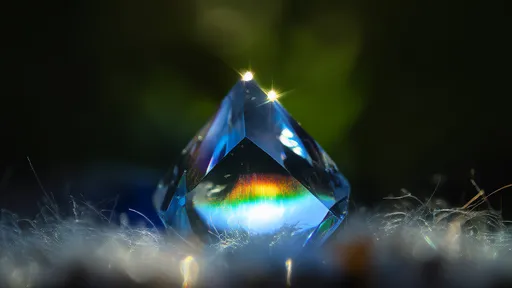
The magic begins with the very structure of these minerals. Atoms within their crystalline lattices are arranged in such perfect symmetry that they become capable of absorbing high-energy photons—often from ultraviolet light—and re-emitting them as lower-energy visible light. This process, known as fluorescence, is not merely a chemical reaction but a delicate dance of electrons. When UV light strikes the mineral, it excites electrons, lifting them to higher energy states. As these electrons return to their ground state, they release energy in the form of glowing, vibrant light. The result is a spectacle that feels both scientific and surreal: a rock that moments ago lay dull and unassuming now radiates with ethereal blues, greens, or reds.
Fluorite, in particular, embodies this dark romance. Its name derives from the Latin word fluere, meaning "to flow," a nod to its historical use as a flux in smelting. But beyond its industrial utility, fluorite possesses an almost theatrical quality. Under UV light, it can fluoresce in stunning shades of blue, purple, or green, depending on impurities within its crystal lattice. Tiny traces of rare earth elements—europium, yttrium, or cerium—act as activators, tuning the mineral’s glow like pigments on an artist’s palette. This variability makes each specimen unique, a one-of-a-kind masterpiece forged over millennia.
What makes this phenomenon so deeply compelling is its duality. By day, these minerals might appear mundane, easily overlooked amidst more dazzling gems. But in darkness, under the right conditions, they reveal their hidden souls. This contrast echoes themes of revelation and concealment—a metaphor for the unseen beauty that exists all around us, waiting for the right moment to shine. It is no wonder that fluorescent minerals have inspired not only geologists but also writers and artists, who see in them a symbol of hope, mystery, and transformation.
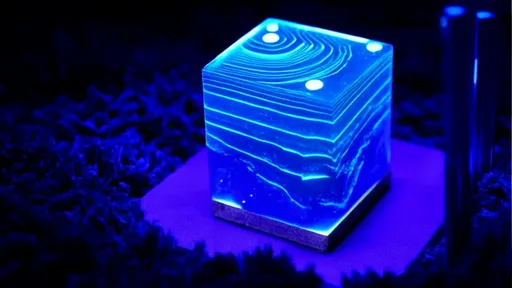
The discovery of mineral fluorescence is itself a tale of serendipity and curiosity. In the 19th century, British scientist Sir George Stokes observed that fluorite emitted visible light when exposed to ultraviolet radiation, a phenomenon he named "fluorescence." His work laid the groundwork for decades of research into luminescence, but it also ignited the public’s imagination. Suddenly, ordinary people could experience a touch of magic by shining a UV lamp on rocks they might otherwise ignore. Today, fluorescent mineral collecting is a passionate hobby for many, with enthusiasts scouring mines and deserts for specimens that come alive in the dark.
Beyond fluorite, other minerals contribute to this nocturnal ballet. Calcite might glow in fiery oranges and reds, while willemite often shines in an intense green. Sometimes, multiple fluorescent minerals appear together in a single rock, creating a symphony of colors that dazzles the eye. In certain famous localities, like the Franklin Mine in New Jersey, entire walls of rock fluoresce under UV light, transforming abandoned tunnels into underground auroras. These displays are reminders that beauty often lies hidden in the most unexpected places.
The appeal of fluorescent minerals also touches on something primal within us—a fascination with light itself. For much of human history, light was synonymous with safety, knowledge, and divinity. To discover that stones could create their own light, independent of the sun or fire, felt like uncovering a natural miracle. Even now, in an age of electric lights and digital screens, the soft, innate glow of a fluorescent mineral feels uniquely authentic. It is light unplugged, unchanged by human hands, and all the more precious for it.
Yet there is also a melancholy undertone to this beauty. Fluorescence is fleeting; it lasts only as long as the energy source persists. Once the UV light is turned off, the glow fades, and the mineral returns to its dormant state. This transient nature mirrors the ephemeral quality of so many wonders in nature—a bloom that lasts for a day, a meteor shower that streaks across the sky in seconds. In this way, fluorescent minerals teach us about impermanence and the importance of witnessing beauty while it lasts.
In the end, the dark romance of mineral fluorescence lies in its marriage of science and soul. It is a phenomenon explainable by quantum mechanics yet felt deeply in the human heart. These stones remind us that the world is full of hidden wonders, waiting for those willing to look beyond the surface. They challenge us to find light in darkness and to see magic in the mundane. And perhaps, in their quiet, glowing way, they offer a metaphor for our own lives: that within each of us, too, there is a latent brilliance, waiting for the right moment to shine.

By /Aug 27, 2025

By /Aug 27, 2025

By /Aug 27, 2025

By /Aug 27, 2025

By /Aug 27, 2025
By /Aug 27, 2025
By /Aug 27, 2025

By /Aug 27, 2025

By /Aug 27, 2025
By /Aug 27, 2025

By /Aug 27, 2025

By /Aug 27, 2025

By /Aug 27, 2025

By /Aug 27, 2025

By /Aug 27, 2025

By /Aug 27, 2025

By /Aug 27, 2025

By /Aug 27, 2025

By /Aug 27, 2025

By /Aug 27, 2025
