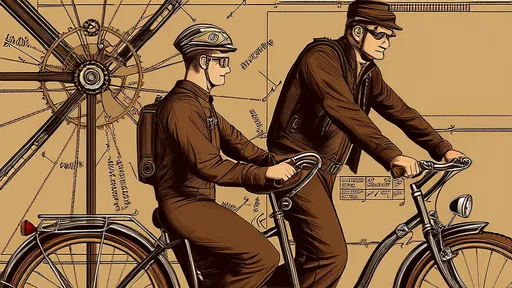
As the morning sun casts long shadows across the river path, a tandem bicycle glides by with near-silent precision. The riders move as one entity, their legs pumping in flawless harmony. To the casual observer, it appears to be a simple feat of coordination, but beneath this graceful motion lies a complex interplay of mechanical engineering and human synchronization—the delicate dance of gear ratios and cadence alignment that makes tandem cycling either a symphony of motion or a struggle for dominance.
The heart of tandem cycling efficiency lies in understanding that two riders are never perfectly matched in strength, stamina, or pedaling style. Unlike solo cycling where the rider alone dictates the rhythm, tandem riding requires what seasoned cyclists call "the conversation of the cranks"—a constant, non-verbal negotiation between partners. The stoker (rear rider) must attune to the captain's (front rider) movements, while the captain must remain sensitive to the stoker's power output and fatigue levels. This dynamic creates a unique engineering challenge: how to translate two different power inputs into one seamless output.
Gear ratio selection becomes critically important in this context. While solo cyclists choose gear ratios based on terrain and personal preference, tandem teams must consider their combined strengths and weaknesses. A common mistake among new tandem teams is selecting gears that are too high, creating a situation where the stronger rider feels constrained while the weaker rider struggles to maintain cadence. The most successful teams often use lower gear ratios than they would on solo bikes, prioritizing maintainable cadence over raw speed. This approach reduces the strain on both riders and prevents the "herky-jerky" effect that plagues poorly coordinated teams.
Cadence synchronization presents another layer of complexity. Humans naturally pedal at different optimal rates—some riders prefer spinning at 90-100 RPM while others favor more powerful strokes at 70-80 RPM. On a tandem, these preferences must be reconciled. The solution isn't necessarily finding a perfect middle ground, but rather establishing what professional tandem racers call "harmonized discord." The stronger rider might pedal slightly slower than their natural cadence while the weaker rider spins slightly faster, creating a complementary rhythm where both riders operate at efficient but different rates within the same revolution.
Modern tandem technology has introduced fascinating solutions to these challenges. Some high-end tandems now feature independent drive systems that allow each rider to pedal at their preferred cadence while still contributing to forward motion. These systems use complex gear trains and differentials to combine power inputs, similar to how hybrid vehicles manage multiple power sources. While still relatively rare due to weight and complexity, these innovations point toward a future where tandem cycling becomes accessible to partners with significantly different fitness levels or physical abilities.
The psychological dimension of tandem synchronization cannot be overlooked. Studies of competitive tandem teams reveal that successful pairs develop what researchers call "kinesthetic empathy"—the ability to feel through the bike what their partner is experiencing. This goes beyond mere communication; it becomes a physical intuition. The captain learns to distinguish between the stoker's powerful push and fatigue-induced struggling through subtle vibrations in the frame. The stoker learns to anticipate gear changes by feeling the captain's body shift position. This deep connection transforms the tandem from mere transportation into what one Olympic tandem pair described as "a four-legged creature with a single mind."
Environmental factors add another variable to the synchronization equation. Crosswinds require the team to lean together as one, while climbing demands careful power management to prevent wheel slip or standing synchronization issues. Descending becomes an exercise in trust and coordinated weight distribution. Each terrain type demands its own subtle adjustments to both gear selection and pedaling rhythm. Experienced tandem teams develop what amounts to a library of coordinated responses to various conditions, switching between them as seamlessly as changing gears.
The maintenance of tandem drive trains requires special attention that many cyclists overlook. Because tandems transmit significantly more power than solo bikes, they experience accelerated wear on chains, cassettes, and chainrings. The complex forces involved—particularly the torsional stress on the bottom bracket and chainset—demand more frequent adjustments and higher-quality components. Many tandem specialists recommend using hardened steel chainrings instead of aluminum, despite the weight penalty, and suggest changing chains at least twice as often as on solo bikes. This mechanical reality underscores the physical demands of synchronized pedaling.
Training for tandem synchronization follows principles quite different from solo cycling preparation. While individual fitness remains important, teams spend most of their practice time developing what coaches call "combined efficiency." This involves drills where riders pedal with one leg only, forcing them to feel each other's power pulses. Other exercises include cadence intervals where the captain suddenly changes rhythm and the stoker must match within two pedal strokes. The best teams can synchronize almost instantly, their pedaling becoming so perfectly aligned that the drive train runs with minimal lateral stress.
Technological advancements continue to reshape tandem synchronization. Power meters now available for both positions allow teams to analyze their efficiency in real-time. Some systems even provide haptic feedback through vibrating saddle inserts or handlebars to signal cadence mismatches. Mobile applications can track synchronization metrics over time, helping teams identify patterns and improvement areas. This data-driven approach has transformed tandem cycling from an art form into a science that still retains its artistic elements.
The future of tandem technology points toward even greater integration of human and machine. Electric assist systems are becoming popular not as replacements for human power, but as synchronization aids that smooth out power disparities between riders. Computer-controlled transmission systems can automatically adjust gear ratios based on real-time analysis of both riders' power output and cadence. Some prototypes even feature active suspension that adjusts damping based on pedaling forces, creating a more stable platform for synchronization. These innovations promise to make tandem cycling more accessible while preserving the essential human connection that defines the experience.
What begins as a mechanical discussion about gear ratios and cadence ultimately reveals itself as a metaphor for cooperation itself. The tandem bicycle becomes a laboratory for human coordination, demonstrating how two individuals can achieve more together than separately, but only through continuous communication, adjustment, and mutual understanding. The precise click of well-chosen gears shifting in unison and the whir of perfectly matched pedals create a rhythm that transcends cycling—it becomes a lesson in harmony that applies to any partnership striving toward a common goal.

By /Aug 27, 2025

By /Aug 27, 2025

By /Aug 27, 2025

By /Aug 27, 2025

By /Aug 27, 2025

By /Aug 27, 2025

By /Aug 27, 2025
By /Aug 27, 2025

By /Aug 27, 2025

By /Aug 27, 2025
By /Aug 27, 2025

By /Aug 27, 2025

By /Aug 27, 2025

By /Aug 27, 2025

By /Aug 27, 2025
By /Aug 27, 2025
By /Aug 27, 2025

By /Aug 27, 2025

By /Aug 27, 2025

By /Aug 27, 2025
