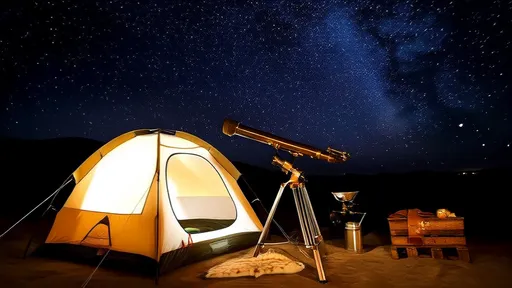
Under the vast velvet dome of the night sky, a new kind of communion with the cosmos is taking root. No longer confined to remote mountaintops or sterile observatories, amateur astronomy has found an intimate and unexpectedly poetic home: the stargazing tent. Paired with a trusty telescope, this simple shelter has transformed the act of celestial observation from a purely scientific endeavor into a profoundly personal, almost meditative ritual. It’s a trend blossoming in backyards, on quiet hillsides, and at dark-sky sites across the world, merging the primal comfort of a cocoon with the boundless wonder of the universe.
The magic begins not with the first glimpse of Saturn’s rings, but with the act of preparation. Unfurling the tent is like setting the stage for a private performance where the headliners are light-years away. There’s a tangible shift in mindset as you zip the door closed, leaving behind the terrestrial distractions—the glow of smartphone screens, the hum of distant traffic, the mental clutter of the day. Inside, the world shrinks to a soft, dark pocket, a sensory deprivation chamber designed not to empty the mind, but to fill it with anticipation. The rustle of nylon, the faint scent of earth and grass, the cool night air held at bay—it all serves to heighten the senses, preparing you for the main event.
And then, there is the telescope. In this context, it ceases to be merely a tool or an instrument. It becomes an extension of the self, a conduit. The familiar ritual of setting it up—mounting the tripod, balancing the tube, carefully inserting the eyepiece—feels different inside the tent’s embrace. The motions are slower, more deliberate, almost reverent. You are not just assembling equipment; you are forging a connection. The confined space forces a physical intimacy with the device; you know its every curve and dial by touch in the near darkness. This is where the sweet focus truly begins—not just the mechanical act of turning a knob until the image snaps into clarity, but the mental and emotional focus required to truly see.
The first moment of observation is always a gasp. Peering into the eyepiece, you are not just looking at a pinpoint of light; you are falling into it. The fabric walls of the tent disappear, and the aperture of the telescope becomes a portal. Jupiter is no longer a bright dot but a swirling marble of cream and ochre, its Galilean moons strung out in a perfect, delicate line. The Moon is not a flat disc but a brutal, beautiful landscape of craters, mountains, and shadows so sharp you feel you could cut yourself on them. The tent enhances this immersion. By blocking your peripheral vision and all earthly reference points, it creates a phenomenon veteran stargazers call ‘aperture vision’—the feeling that the entire universe exists within that single, circular field of view. There is nothing else. Just you, the machine, and the cosmos.
This intense focus unlocks a deeper layer of astronomical appreciation. Freed from the need to constantly scan the sky or check a star chart, you can settle in. You learn the art of ‘seeing’—a term astronomers use to describe the patient practice of waiting for moments of atmospheric stillness to reveal finer and finer details. You watch as the turbulence in our own air momentarily clears, and the Cassini Division in Saturn’s rings emerges from a blur into a razor-thin, black line of nothingness. You trace the delicate, glowing veins of a nebula, a structure that is not truly green to the human eye, but whose form and ethereal nature can only be teased out with long, quiet, concentrated observation. The tent becomes a sanctuary for this patience.
Beyond the visual spectacle, the experience is richly tactile and auditory. The gentle whir of a tracking motor is the only soundtrack. The cool metal of the focuser under your fingertips provides a grounding counterpoint to the dizzying distances on display. You become acutely aware of your own breathing, syncing it with the slow sweep of the telescope as it follows the steady rotation of the Earth. This is astronomy not as a race to catalog objects, but as a form of mindfulness. It’s a conversation with infinity, held from within a small, safe space. The juxtaposition is everything: the ultimate vulnerability of a human under an endless sky, paired with the primal security of a shelter.
For many, this practice has also rekindled a more romantic, historical connection to the stars. Before electric lights, this was how all humans experienced the heavens—from a state of darkness, often from within the confines of a hut, a sail, or a simple blanket. The stargazing tent, in its modern simplicity, accidentally recaptures that ancient intimacy. It reminds us that we are not just observers of the universe, but participants, living on a rocky planet spinning through the very space we are trying to comprehend. The telescope shows us the mechanics; the tent allows us to feel the poetry.
As the night deepens and the temperature drops, the cozy interior becomes a haven of warmth, both physical and emotional. This is where the sweet in sweet focus finds its fullest expression. It’s the contentment of being exactly where you are supposed to be, doing exactly what you are meant to be doing. It’s the joy of sharing the space with a loved one, taking turns at the eyepiece and whispering discoveries in the dark. It’s the sweet triumph of finally resolving a difficult double star or spotting a faint galaxy for the first time. It’s a hobby that engages all the senses and rewards patience with profound beauty.
Ultimately, the stargazing tent and telescope duo represents a perfect marriage of opposites: the immense and the intimate, the high-tech and the primal, the infinite and the personal. It offers a way to touch the cosmos without losing touch with oneself. It proves that you don’t need a million-dollar observatory to have a meaningful relationship with the universe. Sometimes, all you need is a quiet patch of ground, a telescope pointed upward, and a thin layer of fabric to frame the greatest show on Earth—or rather, above it. The sweetest focus is achieved not just by adjusting a lens, but by aligning one’s entire being with the silent, majestic rhythm of the night.

By /Aug 27, 2025

By /Aug 27, 2025

By /Aug 27, 2025

By /Aug 27, 2025

By /Aug 27, 2025

By /Aug 27, 2025

By /Aug 27, 2025

By /Aug 27, 2025
By /Aug 27, 2025

By /Aug 27, 2025

By /Aug 27, 2025

By /Aug 27, 2025

By /Aug 27, 2025

By /Aug 27, 2025

By /Aug 27, 2025

By /Aug 27, 2025
By /Aug 27, 2025

By /Aug 27, 2025

By /Aug 27, 2025

By /Aug 27, 2025
